
What is a Mando in Disc Golf?

There are many terms in disc golf that a new player might not understand when they first start playing. word like ‘overstable’, ‘hyzer’, and ‘flippy’ are used in regular conversations on the course. Another term, and one that we will discuss in this blog, is ‘mando’.
It is important to know what a mando is and how to play a hole that has one. It is also good to know WHY mandos are used, so we can know why it is important to play them correctly. So, let’s learn what a mando is in disc golf!

What is a Mando?
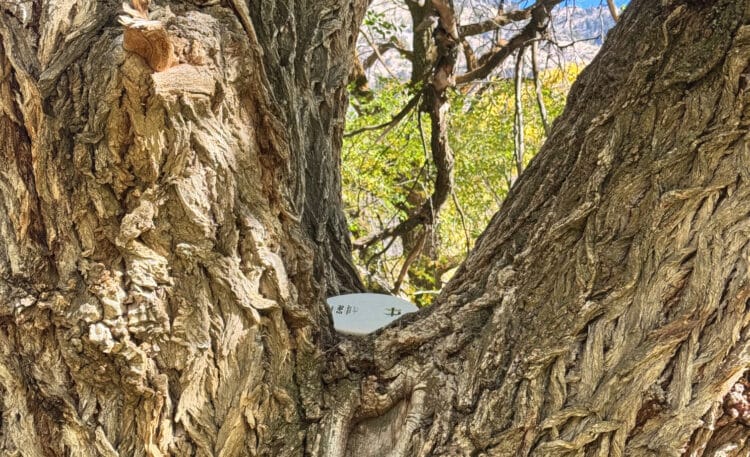
The word mando is an abbreviation of the word ‘mandatory’. In other words, it is mandatory that you throw your disc a certain way on certain holes. You are required to throw on the correct side of an obstacle. If you see a mando sign that is pointing left and attached to a tree, then your disc must fly to the left of the tree. If not, you get a penalty stroke.
Most of the mandos that you’ll see are pointing either left or right. However, sometimes you’ll see a mando that points down. In that instance, you need to throw below whatever object the mando is attached to. Occasionally, as pictured below, you see a triple mando. That means you go between the left and right arrows, and below the top.

Rare Mando
In rare occasions, usually unsanctioned tournaments or events, you’ll see a quad mando. This is basically a rectangle shape that you have to be able to throw your disc through. I’ve only seen quad mandos at casual tournaments.
Sometimes mandos will have the word ‘mando’ on the sign, though not always. They might also be marked with a ribbon or tape to indicate the mando object. If tape or ribbon is used, there should be some indication on the tee sign or in the course rules which directions you need to throw in order to successfully execute the mando. A successful throw is called ‘making the mando’. An unsuccessful throw is a ‘missed mando’
Why Are Mandos Used In Disc Golf?
While mandos should be used sparingly in a course design (in my opinion), there are several reasons why a course designer might decide to include a mando on a hole.
One reason is safety. By forcing players to throw in a certain direction, course designers keep discs from flying over or near playgrounds, parking lots, walking paths, or other players. That makes the course safer and reduces the chances of someone getting hit or property damage from occurring.
Another reason is to make a course more challenging. Designers might intend for people to throw down a difficult, narrow tunnel. If you have the skill and power to throw over the tunnel and land on a green or fairway, it takes the challenge out of the hole. By adding a few mandos, the hole becomes more of a test, and rewards the accurate throw.

One reason designers might include a mando is course flow. Some courses have areas of the course where there are thick bushes or swampy areas, and throwing into those areas would cause delays while people look for their disc. That becomes especially important during a tournament.
A mando might also prevent people from throwing onto another fairway. That might be a safety issue AND a course flow issue. And might be another reason you see a mando on a particular hole.
Mando Rules and Penalties
Now that you know a little about what mandos are and when they are used, let’s look at the PDGA rules that govern mandos and how to play them. The section in the official rules is not very long, and worth a read if you want to brush up on the current requirements. They complete rules are found HERE. I’ll summarize the rules in this blog, but if you plan to play in a sanctioned tournament you should look up the official rules to make sure you understand and follow them.

PDGA 804.01 Mandatory Routes
- A mandatory route restricts the path the disc may take in the process of playing a hole.
- The restricted plane is a vertical plane marked by one or more objects or other markers which define the edges of the space.
- If part of a thrown disc clearly enters into a restricted plane, the player receives one penalty throw. The lie for the next throw is the drop zone for that mandatory. If no drop zone has been designated, the lie for the next throw is the previous lie.
- If the thrown disc is released on the other side of the restricted plane compared to the rear edge of the marker disc, the player has missed the mandatory. The next lie and penalty are the same as 804.01.C.

Mando Strategy
It is often times best to avoid a penalty by not aiming anywhere near the mando. Other times it might be strategic to lay up near the mando, then take a more powerful throw on your next shot. That is especially true on narrow double mandos.
Conclusion
In this blog we’ve learned about mandos in disc golf, why we have them, and the different types. We also looked at the rules of play for mandos. There are many courses with no mandos, but others where they are necessary or desired. It’s good to know why they are there and how to play them.
Best of luck, and may you make all of your mandos!
We don’t sell mandos at Infinite, but we have the best selection of discs and accessories on earth. Check out our newest discs HERE.

 Why Players Disagree About the Rule
 The Future of the Two-Meter Rule