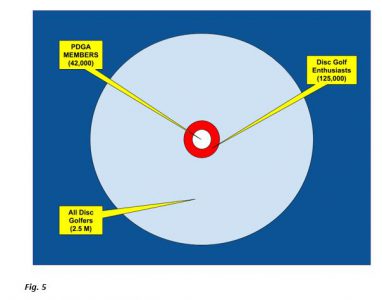
State of Disc Golf: Skill Level
When we start out playing disc golf in a club, we are frequently confronted with the decision of which division is right for us. At a club league, it’s pretty easy to determine whether or not we are playing in the division for our skill level. If we are regularly crushing the competitors in our division, it would be time to move up to the next division. If we are the ones getting beat by significant margins, maybe a lower division would give us more competition.
When we step up to sanctioned tournaments, we have to reevaluate our skill level to determine the best division for us. A local tournament will attract a different skill level for a particular division, versus a national event. Our PDGA rating can help us find the best fit, and sometimes restrict our decisions. Having our rating and seeing how we perform at tournaments and during league can help us overcome the Dunning-Kruger effect (overestimating our skill level).
While the subject of tournaments is something that we will discuss when we analyze the results of that part of the survey, today we will cover how we view our skill level. We will look at the breakdown of skill levels based on other demographics, such as age and gender. Finally, we will look at how those numbers have changed from previous surveys.
Our Skill Level
Let’s start out by looking at how we answered the question, “How would you rate your skill level as a disc golfer?” As discussed above, how we rate ourselves can be based on a variety of things. Even those who chose, ‘Professional’ may have done so for a variety of reasons. Are they playing in the pro division for the competition, despite having a PDGA rating that would qualify them to play in an Amateur division? Here is the breakdown of how we self-identify our skill level.
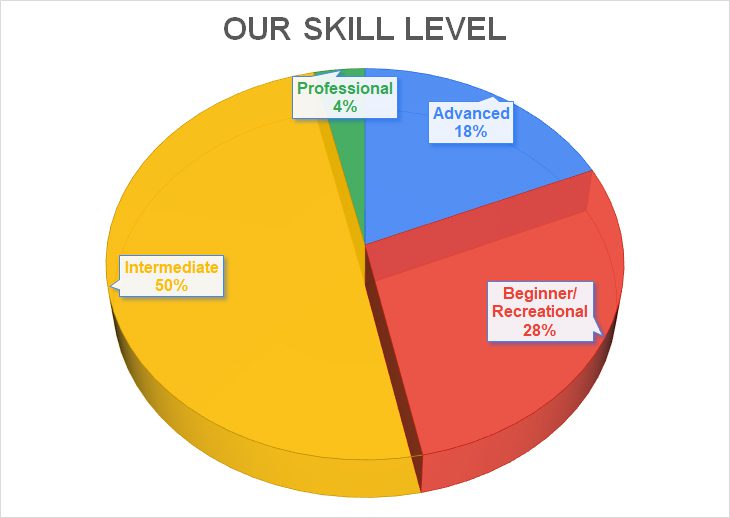
With half of us identifying as having intermediate skills and more than ¾ of us identifying as a beginner or intermediate player, my first thought explaining those numbers is the rapid growth we’ve seen in disc golf the past couple of years. We could conclude that since there were a lot of people who just started playing, they wouldn’t have progressed past the Intermediate level by now. We can look at other data in the survey to see if that hypothesis is correct. First, let’s see how those numbers have changed since earlier surveys.
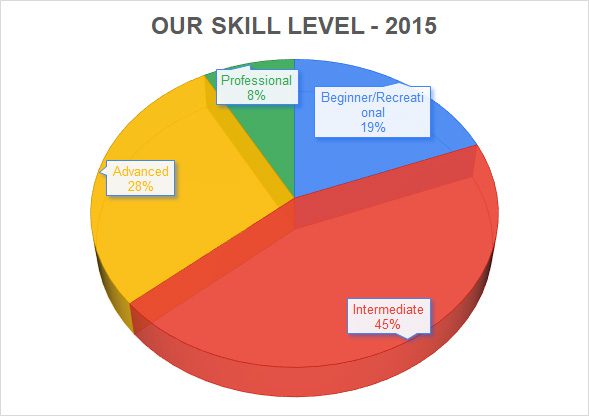
Checking out the survey results from 2015, we see a higher percentage of players identifying as being in the Advanced or Professional divisions than this year’s survey.
Skill vs Time Playing
Let’s compare the skill levels when they are sorted by the year the player started playing disc golf. That should show us how the pandemic affected our skill levels as a group. Here is the chart:

We can see that around 30% of all survey respondents started playing in 2020 or sooner, and identify as a beginner or intermediate player. That certainly accounts for the larger number of total players in those divisions, as compared with the survey results from seven years ago. It will be interesting to see how fast people move up skill levels in future surveys.
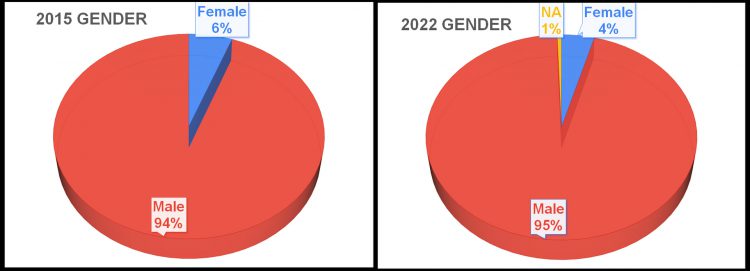
Now let’s take another look at our skill levels and organize them by gender and age. We’ll start by looking at data from last week, our numbers when sorted by gender. Although the number of women taking the survey was up over 2015, the percent of women dropped a bit this year compared to the earlier data. Here is the chart showing the numbers for 2015 and 2022:
Here is how the number of each skill level look, when sorted by gender:
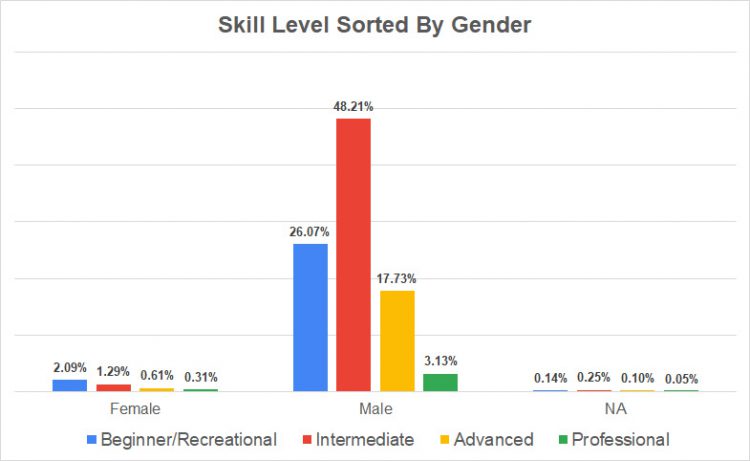
As we can see, the skill level representing the largest number of men is intermediate. It represents 48% of all respondents, and over half of all the men who responded. For the women, the beginner/recreational division is the largest. Nearly half of all women who took the survey are in this skill level.
Sorting By Age
If we were to look at our skill level according to our age group, what would we expect to find? More pros in the prime ages? More beginners in the younger groups? We can find out by sorting age groups into skill levels. We’ll start by looking at the raw numbers, then we’ll sort them by skill level and the percentage in that age group. Here is the raw data:
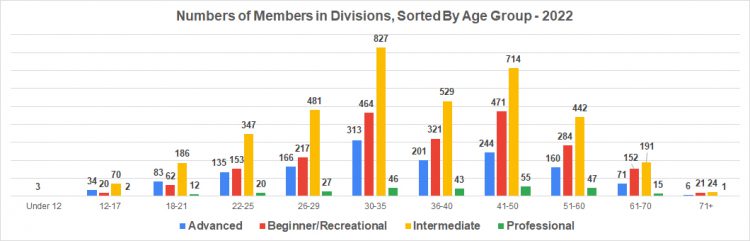
I think it is more interesting to see how each age group is divided according to skill level. In other words, it is more interesting to look at the age group that you play in, for example, and compare it to the same age group in 2015. First, let’s take a look at the results for the most recent survey.
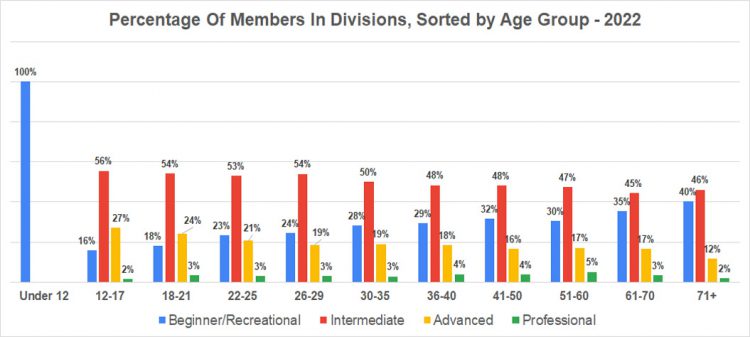
That tells us that the group with the highest number of pros is the 51-60 age group, which has about 5% of its members that are pros. The group with the highest percentage of beginners is the 71+ age group (not counting the under 12 age group). Interestingly, the 12-17 age group has the highest percentage of intermediates AND advanced players.
We can now compare those numbers to the ones in 2015.
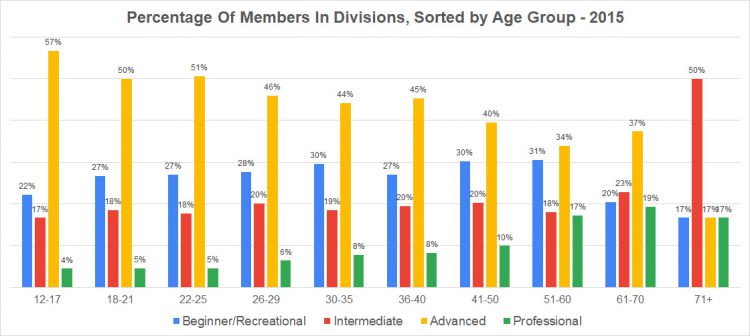
The 2015 graph shows that the 61-79 age group had the highest percentage of pros, with nearly one in five members of the age group identifying as a professional. The 51-60 group took the top honors for the percentage of the most beginners, although the group barely beat the 30-35 and 41-50 age groups. The 71+ age group was the intermediate leader and the 12-17 was the advanced leader, both groups holding on to the titles for 2015 and 2022.
It’s interesting to see the change in how many people consider themselves ‘advanced’ players. There were more advanced players than any other skill level in all but one age group in 2015. But in 2022, the advanced division wasn’t the largest in any group. Instead, the intermediate division was the most popular in every division.
Check back next week when we will continue to look at more survey results.