
Disc Golf Weight Explained – Choosing the Best Disc Weight
Why Weight Matters in Disc Golf
When you shop for a new disc, you likely prioritize finding a weight range that you like. If a disc is too heavy for you, get the distance you want. Too light of a disc and it may be too flippy to be useful. The weight of a disc affects its speed, stability and the way it will fly. In this blog we will discuss how the weight of a disc affects the flight of the disc as well as your disc purchases.
Disc Speed and Distance
There is a solid relationship between how fast a disc is thrown to how far the disc will travel. The faster the throw, the greater the potential to get more distance. There is an exception to this ‘rule’, which we will talk about, but there is a good general relationship between speed and distance.
According to Best Disc Golf Discs’ YouTube Channel, for every mile per hour of disc speed, there is an average increase of about seven feet in distance. Theoretically, an easy way to get more arm speed is to throw a lighter disc. Research shows that throwing a lighter disc can lead to increase in throw speed. As an example, throwing a disc that is 20 grams lighter can result in an increase in speed of 6.5 MPH. That would mean an increase in distance of over 45 feet!
Light Discs = Big Distance
Moving beyond theory and into practice, we have a perfect example of using lighter discs to gain distance. In 2016, David Wiggins Jr threw an R-Pro Innova Boss 1,108.92 feet. According to the Guiness Book of World Records, the Boss weighed 154g. There was a ripping tailwind that contributed to Wiggins crushing the former record by a couple hundred feet.
The former distance record was set the day before by Simon Lizotte. Lizotte was the first person to throw a disc over 900 feet (903.9 feet). The disc he used was a 157g Innova Blizzard Boss. Although angle control and massive tailwinds played a part in both records, so did the lighter discs used.

Disc Stability Also Matters
We’ve established that lighter-weight discs can get you more speed and possibly more distance. Now let’s discuss the flight numbers of the disc and how weight affects those numbers, specifically the stability of the disc (the third and fourth numbers in the four number flight rating).
Because a lighter disc can be thrown faster, it has a tendency to turn to the right more at the fastest part of the throw. How much it turns depends on how fast you throw the disc and what speed rating the disc has.
If you are an advanced player that buys overstable discs that can handle your power, throwing lighter discs might give you nice S-turns that translates to longer throws. If you already throw molds that have a good amount of turn, lighter versions of those molds might be too flippy to handle.
If you are a newer player who struggles to throw 280 feet, lighter discs might be just what you need to get a good flight and break that 300-foot barrier.
Light Discs in the Wind
As a general rule, the lighter the disc, the more it will be affected by the wind. That isn’t always a bad thing. While a headwind will make a disc more flippy and prone to turn (maybe even too much turn), a tailwind will tone down the turn, and likely give you more distance (refer to the record-setting throws above).
Cross winds can also affect lighter discs more than heavier discs. They will either push a disc farther in the direction of the wind, or drop the disc faster, depending on the angle of the disc and the direction of the wind.

Choosing Your Disc Weights
The bottom line in selecting a disc is that it flies good for you at your skill level. If your discs are turning to much for you, you may need faster, heavier, or more overstable discs. If every disc you throw is a meat hook, look for slower, lighter, and more understable discs. Here are a few guidelines for disc selection:
Putter or Midrange Discs
Since putters and midrange discs are typically used for control shots rather than long distance, getting max weight is fine. They won’t be affected by the wind as much as lighter discs, which will help with accuracy. Midrange discs can also be heavier than max putters due to their larger diameter.
If you want a little more distance out of your putter or midrange, you could get a lighter disc. Many midrange discs and putters come in 160’s weight. Lighter discs make it easier to make take longer putts, although they would be affected by the wind a little more.

Fairway and Distance Drivers
The max weight for most fairway and distance drivers is 175g. The lightest discs can dip below 130g. The disc weight that would work best for you depends on your skill level and the flight you are looking for.
Newer Players
Newer players typically lack the skill to throw a driver very fast, which means it won’t go very far. Lighter discs are easier to get faster throws with, and should be the focus for beginners. Look for molds in the 150g range (or possibly even lighter discs), and ones that have a little more turn (-2 to -4). As your skills improve and you can throw faster, you will see more turn in your flights. That would be a good time to look for slightly heavier discs, say around 165-170g.
They would also have the option to look for molds with higher speeds with the same weight, which will mean they will turn less since they require a faster throw. The advantage of getting heavier disc at the lower speed is that the wind won’t affect it as much. A good way to save a few bucks while you are experimenting with discs is to look for sales, misprints, and factory seconds.
Advanced Players
More advanced players can throw faster speeds and often need max weight (and overstable) discs to keep the it from turning and crashing to the ground. Even so, they could still benefit from keeping a lighter driver in their bag for times when they are throwing in a tailwind or up a steep hill.
Many players will have several discs of same mold in their bag, all with different weights, plastic types, or levels of wear. Then they can get a variety of shot shapes with the same familiar feel of the disc.
Other Things That Affect Distance
In this discussion of the weight/distance relationship theory, we are assuming that all other variables that come into play are the same every throw, so we can isolate the role that weight plays. In practice, many other factors come into play when we throw. Grip, nose angle, wobble, and spin all affect the flight shape and distance of a disc. However, for this discussion we just wanted to focus on the role that weight plays in our throws, so we will imagine that everything else is perfect and consistent.

How Are the Weights Listed on a Disc?
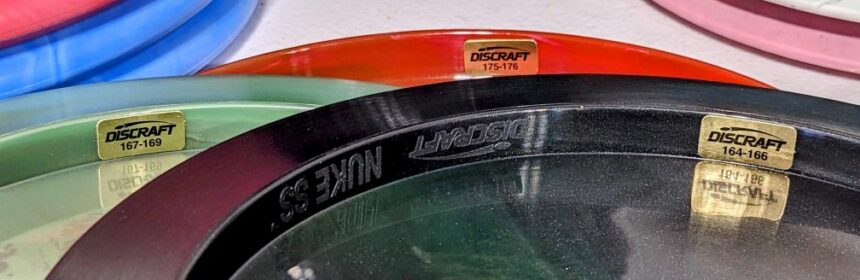
Different brands indicate the weight of their discs in different ways. Some give the exact weight listed on their scale when they weigh them individually. This can be done with ink or with laser etching. Other brands just list a range of weights, even though they are still weighed individually. So, how does Infinite Discs approach the manufacturer’s declared weight?
Long ago, Infinite adopted a policy of trusting the manufacturer to put the correct weight (or weight range) on the disc. They have a vested interest in giving the most accurate weight as possible. Infinite simply lists what ever wight the manufacturer indicates on the disc. If there is a weight range on the disc (like Discraft does) we list the lowest weight in the range. If the manufacturer lists 173-175g on a disc, we go with 173g on our listing. We do that because our system doesn’t allow us to post a range.
We have considered weighing the discs and posting the weight by the picture of the disc, but there are drawbacks to that. Different scales sometimes give different readings for the same disc. Our scales might not agree the manufacturer’s scale, nor with a customer’s scale, which might result in some upset customers! Instead, we post the weight from the manufacturer.
What if We Post the Wrong Weight?
We try to be as accurate as possible when we post the weight of a disc. We even double check before we ship out discs to make sure the weight, color, and mold are the same as what is listed on our website. Even with those guardrails in place, we may end up mislabeling a disc weight. If that happens, we’re happy to help the best we can. Just know that we genuinely try our best to get the disc listed.
We hope that this information has been helpful in understand a little bit more about disc weights and how they affect flight. We hope you better understand how brands mark the weight of their discs, and how we at Infinite Discs work with those brands and trust in those manufacturers to indicate the weight of their discs so that our buyers can make an informed purchasing decision.
Todd Durrant

Todd is the Vice President of Infinite Discs and mastermind behind the Infinite Discs VIP Club. He writes Infinite Discs newsletters and works with pros and artists to create a masterful selection of unique discs for you to enjoy.
Great post. I personally haven’t run into any problems with weight inaccuracies, but it’s good to know that the people at Infinite are doing their best to make sure we get the discs they order. The policies mentioned in this post make sense to me. I appreciate the transparency.
You repeat a paragraph under the headings Disc Stability Also Matters and Factoring in Wind Conditions.
Thanks! Got it fixed.
It’s great to see that you’re quietly backing away from your “we don’t weigh discs” policy, esp. given how important it is to customers according to your own surveys. Thank you!
Thank you also for stocking the lightweight stuff! I think it’d be great if you could carry more of the lighter F2s and x-outs that are out there but typically require some sleuthing to find – usually only buried somewhere in a manufacturer’s website. Your site is top-notch when it comes to finding light discs and I’d buy more of them if they were available!
This is the first article relating to weight I’ve read. I’m 66 and have been a player for 8 years. I can tell you with certainty that weight matters! Disc speed is critical and with lighter weight discs, my disc speed improves dramatically. I hope that Innova and other manufacturers will focus more on what is still considered a specialty disc. Thank you.
A 71-year-old, slight build, small hands, slow-arm thrower, I first touched a golf disc in April 2018. Like many, began with a 170g-range starter set. Quickly realized I’ll never have a power arm, so based on advice from experienced older players, started experimenting with lighter weight discs. Now carry mostly ultralight 135-144g drivers and lightweight 154-158g mids & throwing putters (still 170g putting putters).
Most of my drivers are Innova—the only disc maker who consistently releases their full driver line in ultralight premium plastics—but have experience with most of the ultralight plastic available. Loved Prodigy’s 400g (not ‘Air’) 141-145g D1/D2/D3/D4. They’re my all-time favorites but I couldn’t replace lost 141g D1 and 142g D2 (have them at 147g and higher but it’s not the same). I like MVP’s 146g Elaine King Photon (seasoned); 143g Wave; and seasoned145g /newer more overstable 140g Tesla. Those weights are super-rare—I’m really disappointed that MVP and Prodigy don’t regularly release them. Their relative irreplaceability is one reason none are in my daily cart. I do have all-MVP and all-(OOP)-Vibram 8-disc bags I play 3-4 times a month, only on my very open, hard-to-lose-discs home course.
(btw, my Wave is new—longer and allows a much more consistent release than the 147g I’d been using; same with a new Reactor at 155g versus the old 160g —thanks MVP! Can we get some Photons closer to 140g? Perhaps some others?)
Flipping open the cart I’ll be playing later today, I’m carrying fourteen Innova drivers ranging from 134g to 147g. Heaviest is a Star Destroyer (headwinds); longest (depending on wind) are 136g Champ Tern & 144g Halo Mamba (only ultralight Halo driver I’ve ever seen—wish there were more); lightest a Barsby Star Roadrunner (long tunnel hyzerflip). Also Star/Champ/GStar Destroyers, Tern, Wraith, Firebird, Valk, Teebird3, TL3, Hawkeye. Other discs: 152g-157g Innova, MVP, Kastaplast, and ABC mids; and Gateway Lunar Soft 170g Wizard/154g Chief putters.
After all that, two more things to keep in mind.
• The Diminishing Returns Curve. Distance results not just from release speed, but how quickly air resistance slows the disc down. A lighter disc both starts and slows down faster. When I started down-weighting, the diminishing returns point was in the lower 160 grams. I probably waited too long to go through the 150s to 140s. Never dropped down until I was consistently throwing the same disc in a lower weight, farther (like the Wave I mentioned above). Current driver sweet spot is lower 140s/upper 130s.
• Training Aid. Ultralight discs react much more obviously to bad technique, like OAT or a nose-up release. Heavier discs tend to damp those tendencies. If you want to hone your release, try reps throwing ultralights of varying stability at 70% power.
Great post Purple! I totally agree with you – Innova is best when it comes to lightweight drivers. I’ve also found that I get surprising distance from their mids in lightweight premium plastics – champion Lions, Roc3s, Wombat3s and star RocX3s in particular.
MVP’s Trail is a bomber for me. You might want to look into Lone Star – most of their lineup is available in lightweight Lima plastic. Gateway has a number of drivers in lighter weights. Finally, Trilogy discs in “air” or “zero-gravity” plastics have worked well for me.
I’m looking forward to the new Prodigy 100 plastic that’s coming later this week!!