
The PDGA Disc Approval Process

January 1, 1964 is a significant date in disc golf history. Sort of. That’s the date the PDGA lists as the first disc ever officially approved in their database. However, the PDGA didn’t exist at that time. Here’s how that went down.
The PDGA was founded in 1976. That was when they first started developing standards for what a disc golf disc should look like. That was the beginning of the approval process, but that didn’t address the discs that had been in play for years.
The approval dates for the first few discs were actually selected retroactively after the PDGA began, and were chosen based on the manufacture dates of the discs. According to the Flying Disc Museum website, prior to 1990 there were only a few standards that needed to be met for a disc to get approved. In fact, many discs were grandfathered in to the approved list and no application nor disc sample exists for those molds.
Early Requirements
One of the catalysts for developing standards that continue to this day is a man by the name of Jeff Homburg. This Tuscon resident has been approving discs and baskets for the PDGA since 1989! Check out this interesting blog from UDisc that details Jeff and the tools he uses to approve discs, HERE.
Early PDGA requirements were fairly simple. A disc had to:
- Weigh ≤ 200 g, and
- Weigh ≤ 8.3 g per cm of diameter,
- Be at least 21 cm in diameter,
- Have rim depth ≥ 5% of diameter.
In 1994, additional limits were added for rim sharpness, rim configuration, and disc rigidity (flex test). Over the next few decades, the requirements were refined and modified to include detailed measurement of rim depth, rim width, diameter, height, flexibility, stiffness, and sharpness. Even though there were more requirements that had to be met, the number of discs submitted for approval grew and grew.
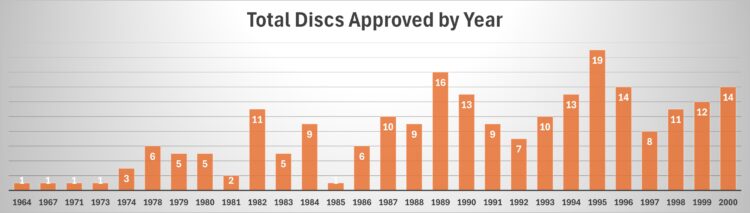
As disc golf became more popular, there was a growing need for additional standards. The technical standards used to approve a disc today have been a work in progress, and have changed over time. Let’s check out the current approval process along with the current technical standards.
So, You Want to Get a New Disc PDGA Approved…
Obviously, the first step in getting a disc approved is to design and make a sample disc. The disc can be made with injection molding, but you can also use a 3D Printer or CNC machine. You’ll need three samples of the disc. Those samples go directly to Jeff Homburg. You’ll also need to submit a PDGA Disc Golf Disc Certification Request.
The fee to assess your mold is $300. Manufacturers who are in their first year of submitting discs receive a 50% discount. Once Jeff confirms that the fee has been paid and the Certification Request has been received, he will test the discs to make sure they fall withing the parameters set by the PDGA.
Specifications
There are nine measurements that are taken, using several different tools. Those measurements include:
- Overall diameter,
2. Height,
3. Rim depth,
4. Rim width (thickness),
5. Inside rim diameter,
6. Rim configuration,
7. Leading‑edge radius (sharpness),
8. Flexibility, and
9. Flight‑plate thickness.
There are other considerations, such as no inflatable components, must be a non-magnetic material, electronics cannot be exposed, etc. Also, the disc cannot exceed 200 grams. For a complete list of technical standards, download the PDGA spec requirements HERE
If the discs submitted meets the guidelines set by the PDGA, the disc is approved for play in sanctioned tournaments. The specifications are then posted on the PDGA Approved Disc Golf Discs page.
If the disc is not approved, the manufacturer is notified of the failure and is told what specifications did not meet the requirements. Then the manufacturer can make changes to the disc in an attempt to bring the mold into the proper specs, then resubmit the disc.
How Many Discs Have Been Approved?
As you saw in the chart above, every year there are many molds submitted for PDGA approval. However, you really need to look at more recent data to see how the sport has blossomed recently.
Here is a chart showing the number of molds approved since the year 2000:
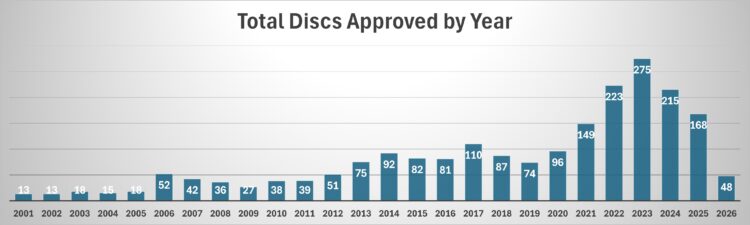
The growth of the sport in the last couple decades has led to a boom in the number of molds approved by the PDGA. Particularly in the last 5 years, when the pandemic gave disc golf a boost in sales, and new manufacturers emerged in an attempt to cash in on the increased demand.
How is This Year Looking
I pulled the data for the current year on March 20 (for a different blog), so I decided to get the data for March 20 of the past 6 years to see how this year compared to the boom years of the pandemic. Here are the results:
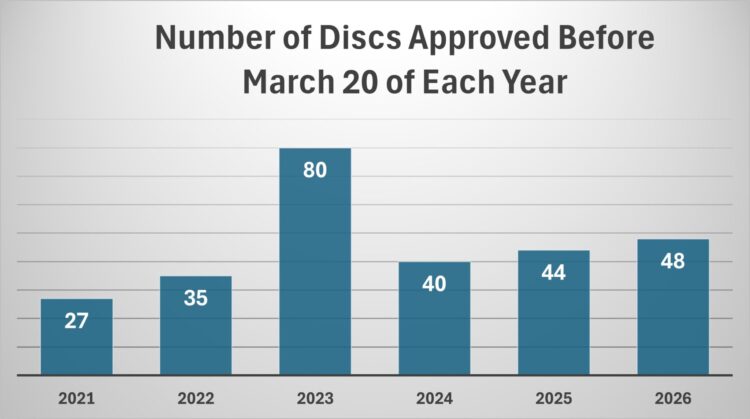
Other than the hot start in 2023, the year that saw more total molds approved than any other year in history, this year might be shaping up to be another great year for manufacturers. We’ll check back later in the summer to see how this year compares to past years.
PDGA Approved
Now when you see ‘PDGA Approved’ on a disc, you know what the disc went through to be able to make that proclamation. It may sound like a lot to go through, but it ensures that the discs our competitors are using fall within certain guidelines, which prevents players from having an unfair advantage. There are still discs out there that aren’t PDGA approved (like the fun and interesting Oxymoron), but those can’t be used in sanctioned competition.
Ted Hegemann

Ted is the Chief Writer at Infinite Discs. He is responsible for the State of Disc Golf Survey articles and most of the "best discs" posts. Ted runs all kinds of local disc golf leagues and tournaments and tournaments in Northern Utah.